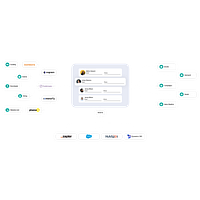
CRM migration
Field-level mapping, validation, and rollback between Knock CRM and HighLevel. We move data and schema; workflows are rebuilt natively in HighLevel.

Knock CRM
Source
HighLevel
Destination

Compatibility
11 of 11
objects map 1:1 between Knock CRM and HighLevel.
Complexity
BStandard
Timeline
48–72 hours
Overview
Knock CRM is built for multifamily leasing teams with specialized objects: Leads with guest-card data, Properties as company records, Deals tied to lease pipelines with stage probabilities, and built-in scheduling via Knock Now. HighLevel uses a generalized CRM model — Contacts, Companies, Opportunities with pipeline stages — plus a Workflows engine for automation and Custom Objects for domain-specific data. The migration carries Knock's core data objects into HighLevel's equivalent structure. Guest-card fields map to custom Contact fields; Knock Properties become HighLevel Companies; Knock Deal pipelines map to HighLevel Opportunities with pipeline stages. Activity history (tasks, notes, appointments) migrates as HighLevel Tasks and appointments. Custom properties from Knock require either direct field mapping or custom field creation in HighLevel. Knock's specialized leasing workflows — tour confirmation sequences, follow-up reminders, lease renewal alerts — do not transfer automatically. They must be rebuilt in HighLevel's Workflows builder using the exported definitions as a reference guide. Knock Now scheduling integrations, third-party property management connections, and any embedded call tracking are out of scope and must be reconfigured post-migration.
Every standard and custom field arrives verified.
AI proposes the map; you confirm before any record moves.
Parent–child, lookups, and ownership stay linked.
Calls, emails, meetings — with original timestamps.
Documents, uploads, and inline notes move with the record.
Why teams make this switch
Leaving
What's pushing teams away
Choosing
What's pulling them in
Object mapping
Each row shows how a Knock CRM object lands in HighLevel, including any object-level transformations, lookup resolution, or schema-design dependencies.
Typical mapping — final map is confirmed during the sample migration step.
Knock CRM
Contact / Lead
HighLevel
Contact
1:1Knock's Lead object maps directly to HighLevel Contact. Guest-card fields including source, move-in date, budget, and unit preference migrate as custom fields on the HighLevel Contact record. Original Knock lead ID is preserved as a custom field for traceability and delta-run de-duplication. Any custom properties attached to the Lead in Knock that don't have direct HighLevel equivalents are migrated as additional custom fields, ensuring no data is lost during the transition.
Knock CRM
Property
HighLevel
Company
1:1Knock Properties representing apartment communities or buildings map to HighLevel Companies. Property-level fields including address, unit count, amenities, and market rent migrate as custom fields on the HighLevel Company record. Parent-property hierarchies are mapped to HighLevel Company relationships where applicable, preserving the organizational structure of the portfolio.
Knock CRM
Deal (Lease Pipeline)
HighLevel
Opportunity
1:1Each Knock Deal represents a lease application or renewal tied to a specific unit and prospect. Deals map to HighLevel Opportunities with the pipeline configured as an Opportunity pipeline. Deal stage (Applied, Approved, Leased, Renewed) maps to Opportunity stage within the target pipeline.
Knock CRM
Deal Stage
HighLevel
Opportunity Stage
1:1Knock deal stage values including Applied, Under Review, Approved, Leased, Lost, and Renewed map value-by-value to corresponding HighLevel Opportunity pipeline stages. Stage-entry timestamps from Knock are preserved as custom datetime fields on the Opportunity record for reporting continuity and historical tracking purposes.
Knock CRM
Task (Tour, Follow-up, Reminder)
HighLevel
Task
1:1Knock tasks tied to tours, prospect follow-ups, and lease renewal reminders map to HighLevel Tasks. Task type (Tour, Call, Email, Custom) preserved in a custom task-type field. Original due dates, assignees (resolved by email match), and completion status carry over.
Knock CRM
Note / Activity Log
HighLevel
Note
1:1Knock notes attached to guest cards or deal records migrate as HighLevel Notes with their rich-text formatting fully preserved during the transfer. Notes are linked to the parent Contact or Opportunity record using HighLevel's note association model, maintaining the contextual relationship between notes and the records they reference.
Knock CRM
Attachment (Lease Document, ID Scan)
HighLevel
File
1:1Files attached to Knock guest cards or deal records, including lease applications, ID scans, and addendum documents, are downloaded and re-uploaded to HighLevel Files, then linked to the corresponding Contact or Opportunity record. Original file names and MIME types are preserved to maintain document integrity and ensure compatibility with downstream processes.
Knock CRM
Tag / Label
HighLevel
Tag
1:1Knock tags applied to leads and deals, such as 'high-intent', 'referral', or 'renewal-candidate', migrate as HighLevel Tags. These tags are applied to the corresponding Contact or Opportunity record during migration and become available for HighLevel Workflow triggers post-migration, enabling automated sequences based on lead or deal classification.
Knock CRM
Custom Property (Guest Card Field)
HighLevel
Custom Field (Contact / Company)
1:1Knock's guest-card custom properties (e.g., 'Desired Move-In', 'Lease Term Preference', 'Budget Range', 'Source Channel') that do not map to a standard HighLevel field are created as custom fields on the Contact or Company object. Field type is matched as closely as possible: date fields to date pickers, text fields to text inputs, pick-lists to choice fields.
Knock CRM
User / Owner (Leasing Agent)
HighLevel
User
1:1Knock owner records (leasing agents, property managers) are resolved against HighLevel users by email address. Unmatched owners are flagged before migration; records can be assigned to a fallback user or held pending HighLevel user provisioning. Owner history on deals is preserved as a custom field.
Knock CRM
Knock Now Scheduling Data
HighLevel
Custom Field / Calendar Event
1:1Knock Now tour scheduling data (appointment slots, calendar links, confirmed times) has no direct HighLevel equivalent. Scheduling configuration must be rebuilt in HighLevel's Calendar tool. Historical appointment records that exist as completed tasks migrate as Task records with appointment metadata preserved in custom fields.
| Knock CRM | HighLevel | Compatibility | |
|---|---|---|---|
| Contact / Lead | Contact1:1 | Fully supported | |
| Property | Company1:1 | Fully supported | |
| Deal (Lease Pipeline) | Opportunity1:1 | Fully supported | |
| Deal Stage | Opportunity Stage1:1 | Fully supported | |
| Task (Tour, Follow-up, Reminder) | Task1:1 | Fully supported | |
| Note / Activity Log | Note1:1 | Fully supported | |
| Attachment (Lease Document, ID Scan) | File1:1 | Fully supported | |
| Tag / Label | Tag1:1 | Fully supported | |
| Custom Property (Guest Card Field) | Custom Field (Contact / Company)1:1 | Fully supported | |
| User / Owner (Leasing Agent) | User1:1 | Fully supported | |
| Knock Now Scheduling Data | Custom Field / Calendar Event1:1 | Fully supported |
Gotchas + challenges
Platform-specific issues from each side, plus the pair-specific challenges that don't show up on either platform's page on its own.
Knock CRM gotchas
Prospect-to-Unit linkage is not a foreign key in all exports
Attribution data is a Prospect property, not a separate object
Pipeline stages are property-specific, not global
Lease records may lack full document blobs in standard export
HighLevel gotchas
Sub-account architecture creates isolated data silos per client
Usage-based telecom and AI costs are not in the subscription price
Workflows have no native equivalent in most destination CRMs
API rate limits cap bulk migration throughput at 100 requests per 10 seconds per sub-account
White-label configuration and branding assets do not export via API
Pair-specific challenges
Migration approach
Audit Knock data model and configure HighLevel pipelines
FlitStack pulls a full export from Knock CRM covering Contacts, Properties, Deals, Tasks, Notes, and Attachments. We catalogue every custom guest-card field, deal pipeline, stage name, and owner record. Simultaneously, we deliver a HighLevel pipeline-setup plan — one HighLevel Opportunity pipeline per Knock deal pipeline, with stage names, ordering, and probabilities specified — so your HighLevel admin pre-creates the schema before any data is loaded. If the Knock export reveals more than 40 custom fields on Contact, we recommend the Custom Object approach and document the schema change.
Map fields and validate owner resolution
Every Knock field maps to a HighLevel field or custom field per the object_mapping plan. Owner emails in Knock Deals are cross-referenced against your HighLevel user list — matched users get their records assigned directly; unmatched owners are flagged with a fallback assignment and a custom field preserving their original Knock email. Custom fields (Desired Move-In, Budget Range, Unit Type Preference, etc.) are created in HighLevel as part of the pre-migration setup. We run a field-count check against HighLevel plan limits and escalate if the Custom Object approach is needed.
Run sample migration with field-level diff
A representative slice of 100–500 records migrates first — spanning Contacts, Properties, Deals across different pipelines and task types. We generate a field-level diff comparing source Knock values against the HighLevel destination records. You verify that deal stage mapping is correct, guest-card custom fields appear on Contact records, and owner resolution worked. Any field mapping errors are corrected before the full run commits. Sample migration also confirms that Knock Now appointment metadata in custom task fields is readable in HighLevel's UI.
Execute full migration with delta-pickup window
Full data load runs against HighLevel. A delta-pickup window (24–48 hours after the initial load) captures any records created or modified in Knock during the cutover — important for active leasing teams who continue processing prospects while the migration runs. All operations are logged in the FlitStack audit trail. After the delta window closes, we run a reconciliation check comparing record counts and field completeness between Knock and HighLevel. One-click rollback is available if the reconciliation reveals gaps exceeding the agreed tolerance threshold.
Deliver post-migration handoff and rebuild reference
FlitStack delivers a migration summary report: record counts by object, field-level diff summary, unresolved owner list, and any custom field notes. We export Knock workflow definitions as a reference document for your HighLevel admin to use when rebuilding tour confirmation sequences, follow-up reminders, and renewal alerts in HighLevel's Workflows builder. A 30-minute post-migration call walks your team through the HighLevel record layout, verifies file attachments, and confirms that deal pipeline stages match the intended business process.
Platform deep dives
Knock CRM
Source
Strengths
Weaknesses
HighLevel
Destination
Strengths
Weaknesses
Complexity grading
Standard CRM migration. 2 of 8 objects need a mapping; the rest are 1:1.
Overall complexity
Standard migration
Derived from compatibility, mapping clarity, API constraints, and data volume across Knock CRM and HighLevel.
Object compatibility
2 of 8 objects need a mapping; the rest are 1:1.
Field mapping clarity
Field mapping is derived from defaults — final spec confirmed during the sample migration.
Timeline complexity
8-object category — typical timelines run 2–7 days end-to-end.
API constraints
Knock CRM: Not publicly documented.
Data volume sensitivity
Knock CRM doesn't expose a bulk API — REST + parallelization used for high-volume runs.
Estimator
Rule-based pricing — no per-record fees, no manual quotes. Migrations over 2M records are scoped individually.
Step 1
Pick a category, then your source and destination platforms.
Category
FAQ
Answers to the questions buyers ask most during Knock CRM to HighLevel migration scoping. Not seeing yours? Book a call.
Walk through your Knock CRM to HighLevel migration with a real engineer — 30 minutes, free, written quote within 24 hours.
Book a free 30 minute consultationAdjacent paths
Other ways to leave Knock CRM









Other ways to arrive at HighLevel
Popular CRM migrations


Ready when you are
Tell us record counts and timeline. We'll come back with a written quote inside 1 business day — no commitment, no sales pitch.