CRM migration
Field-level mapping, validation, and rollback between Zymplify and Salesforce Sales Cloud. We move data and schema; workflows are rebuilt natively in Salesforce Sales Cloud.
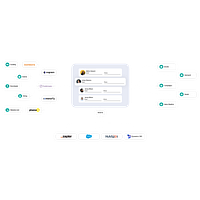
Zymplify
Source
Salesforce Sales Cloud
Destination

Compatibility
10 of 17
objects map 1:1 between Zymplify and Salesforce Sales Cloud.
Complexity
BStandard
Timeline
4-6 weeks
Overview
Moving from Zymplify to Salesforce is a structural migration that also surfaces a fundamental platform design difference: Zymplify is an intent-first GTM platform where CRM functions are secondary to buyer signal aggregation, while Salesforce is a CRM where intent data is an enrichment layer. We migrate Companies to Accounts, Contacts to Leads or Contacts depending on lifecycle stage, Deals to Opportunities, and Activity history via the Bulk API 2.0. Zymplify-native constructs — Bombora-powered intent scores, G2 Buyer Intent signals, Sales Cadences, and Marketing Workflows — have no direct Salesforce equivalent. We extract intent scores and signal sources as custom fields on Account, export cadence and workflow logic as a written requirements specification, and flag that your admin rebuilds them in Salesforce Flow or a Sales Engagement tool post-migration. Vendor lock-in from Zymplify's thin integration ecosystem (only four confirmed native integrations) is the primary reason migration scoping requires bespoke API handling rather than a connector-based export.
Every standard and custom field arrives verified.
AI proposes the map; you confirm before any record moves.
Parent–child, lookups, and ownership stay linked.
Calls, emails, meetings — with original timestamps.
Documents, uploads, and inline notes move with the record.
Why teams make this switch
Leaving
What's pushing teams away
Choosing
What's pulling them in
Object mapping
Each row shows how a Zymplify object lands in Salesforce Sales Cloud, including any object-level transformations, lookup resolution, or schema-design dependencies.
Typical mapping — final map is confirmed during the sample migration step.
Zymplify
Contact
Salesforce Sales Cloud
Lead or Contact (split required)
1:manyZymplify Contact records with lifecycle stage values indicating an unqualified prospect (subscriber, marketing qualified) map to Salesforce Lead. Contacts with sales-qualified or customer lifecycle stages map to Salesforce Contact tied to an Account. We compute the split at migration time using Zymplify's lifecycle stage property and preserve the original stage in a custom field zymplify_lifecycle__c on both Lead and Contact for audit. The CDP Hub's contact records carry enrichment provenance that we surface as a custom field zymplify_enrichment_source__c.
Zymplify
Company
Salesforce Sales Cloud
Account
1:1Zymplify Company records map directly to Salesforce Account. The Company domain maps to Account Website and serves as the dedupe key during import. Each Company carries intent signal metadata (Bombora-powered intent spikes, G2 Buyer Intent signals) that we extract and write as custom fields on the Account: zymplify_bombora_intent__c, zymplify_g2_intent__c, and zymplify_signal_source__c. Account is created before any Contact import so that the AccountId lookup is satisfied at Contact insert.
Zymplify
Deal
Salesforce Sales Cloud
Opportunity
1:1Zymplify Deals map to Salesforce Opportunity. Pipeline stages map to Salesforce StageName via a configurable mapping table. We flag that Zymplify Deals commonly lack a required Close Date or Amount — a structural difference from Salesforce's mandatory Opportunity fields. During scoping, we identify Deals without Close Date and either apply a default migration-date close date or surface them as a data-quality issue for customer remediation before import.
Zymplify
Deal Stage
Salesforce Sales Cloud
Opportunity Stage
lossyZymplify pipeline stages map to Salesforce Opportunity Stage values. We create a Salesforce Record Type and corresponding Sales Process that whitelists the relevant stage values before migration begins. Stage probability percentages from Zymplify migrate to Salesforce StageProbability rounded to the nearest integer.
Zymplify
Sales Cadence
Salesforce Sales Cloud
Sequence definition (documented, not migrated)
lossyZymplify Sales Cadences are outreach sequences combining email steps, delays, and task actions. They have no direct Salesforce equivalent in Sales Cloud. We export the cadence structure (steps, delays, action types, trigger conditions) as a sequence definition document and recommend the customer rebuild using Salesforce Sales Engagement (High Velocity Sales) or a standalone Sales Engagement platform. The cadence step content (email templates, tasks) migrates as Salesforce EmailTemplate records and Task templates for manual admin use.
Zymplify
Marketing Workflow
Salesforce Sales Cloud
Workflow specification (documented, not migrated)
lossyZymplify Marketing Workflows are automation builders with triggers, conditions, and actions that do not transfer to Salesforce Flow as code. We document every active Zymplify workflow (trigger, conditions, actions, sequence) as a requirements specification that the customer's Salesforce admin or a Salesforce partner uses to rebuild equivalent Flow automations. Workflow documentation is delivered as part of the migration handoff package.
Zymplify
Customer Success Hub / Churn Forecast
Salesforce Sales Cloud
Custom fields on Account or custom Success Plan object
lossyZymplify customer health scores and churn risk indicators are native calculations with no Salesforce equivalent. We export the raw health metrics (risk signals, health score components) as custom fields on Account: zymplify_health_score__c, zymplify_churn_risk__c, and zymplify_risk_factors__c. The scoring model itself is not portable; we document it for the customer to rebuild in Salesforce using Flow formulas or a health-score app from the AppExchange.
Zymplify
CDP Hub / Data Cleansing Records
Salesforce Sales Cloud
Contact and Account (enrichment provenance preserved)
1:1List management and deduplication records from Zymplify's CDP Hub carry enrichment status and source attribution. We import the cleansed contact data as Salesforce Contact records and add a custom field zymplify_cdp_status__c that records the enrichment and deduplication decision. Source-of-record attribution migrates to a custom field so downstream enrichment tools can distinguish Zymplify-enriched records from records enriched post-migration.
Zymplify
Product
Salesforce Sales Cloud
Product2
1:1Zymplify products map to Salesforce Product2 records with Standard Price Book entries created during import. ProductCode maps from Zymplify's SKU field. If Zymplify products are associated with Deals, we also migrate Line Items after resolving the Pricebook2 reference.
Zymplify
Engagement: Email
Salesforce Sales Cloud
EmailMessage + Task
1:1Zymplify email engagements migrate to Salesforce EmailMessage records (email content) linked to an Activity Task record (timeline entry). The WhoId on Task points to the migrated Lead or Contact; WhatId points to the related Opportunity or Account. Activity ordering is preserved by setting ActivityDate to the original Zymplify timestamp.
Zymplify
Engagement: Call
Salesforce Sales Cloud
Task (TaskSubtype = Call)
1:1Zymplify call engagements map to Salesforce Task with TaskSubtype = Call. Call duration and disposition from Zymplify transfer to custom Task fields. The Activity timeline ordering is preserved using the original Zymplify timestamp as ActivityDate.
Zymplify
Engagement: Meeting
Salesforce Sales Cloud
Event
1:1Zymplify meeting engagements map to Salesforce Event with StartDateTime, EndDateTime, and Location preserved. Attendee mapping creates EventRelation records pointing at the migrated Leads, Contacts, and Salesforce Users. Location and meeting notes from Zymplify migrate to the Event Description field.
Zymplify
Engagement: Note
Salesforce Sales Cloud
Note
1:1Zymplify Notes (engagement type NOTE) migrate to Salesforce Note records linked via ContentDocumentLink to the parent record (Lead, Contact, Account, Opportunity). Rich text and attachment references in Zymplify Notes migrate as Salesforce Note body text; actual file attachments migrate as ContentDocument records with ContentDocumentLink to the parent.
Zymplify
Engagement: Task
Salesforce Sales Cloud
Task
1:1Zymplify Task engagements map to Salesforce Task with Status, Priority, and ActivityDate preserved. Task assignment migrates by resolving Zymplify hub_id to Salesforce UserId via the User mapping.
Zymplify
Custom Property
Salesforce Sales Cloud
Custom Field
lossyZymplify custom fields are supported across all object types but the export schema is not publicly documented. We discover the custom field inventory during the discovery phase — querying Zymplify's API to enumerate field names, types, and object assignments — and map each field to a typed Salesforce custom field. Field types are resolved at discovery: text to Text(255) or TextArea, numeric to Number, date to Date, picklist to Picklist. Custom field naming follows Salesforce __c convention with a zymplify_ prefix to distinguish migrated fields.
Zymplify
User / Team Member
Salesforce Sales Cloud
User
1:1Zymplify User records include role, hub assignment, and ownership relationships. We map active users to Salesforce User by email match. Any Zymplify User without a matching Salesforce User goes to a reconciliation queue for admin provisioning before record import. Role-based access information from Zymplify is preserved as a custom field zymplify_role__c on the mapped Salesforce User record.
Zymplify
Tag / Label
Salesforce Sales Cloud
Custom field (comma-separated) or Topic
lossyTags applied to Zymplify Contacts and Companies are Zymplify-native. We export tags as a custom text field zymplify_tags__c (comma-separated) on the relevant Salesforce object. If the customer prefers Salesforce's native tagging taxonomy, we deliver a tag vocabulary document for the admin to rebuild using Salesforce Topics or a custom multi-select picklist.
| Zymplify | Salesforce Sales Cloud | Compatibility | |
|---|---|---|---|
| Contact | Lead or Contact (split required)1:many | Fully supported | |
| Company | Account1:1 | Fully supported | |
| Deal | Opportunity1:1 | Fully supported | |
| Deal Stage | Opportunity Stagelossy | Fully supported | |
| Sales Cadence | Sequence definition (documented, not migrated)lossy | Fully supported | |
| Marketing Workflow | Workflow specification (documented, not migrated)lossy | Fully supported | |
| Customer Success Hub / Churn Forecast | Custom fields on Account or custom Success Plan objectlossy | Mapping required | |
| CDP Hub / Data Cleansing Records | Contact and Account (enrichment provenance preserved)1:1 | Mapping required | |
| Product | Product21:1 | Fully supported | |
| Engagement: Email | EmailMessage + Task1:1 | Fully supported | |
| Engagement: Call | Task (TaskSubtype = Call)1:1 | Fully supported | |
| Engagement: Meeting | Event1:1 | Fully supported | |
| Engagement: Note | Note1:1 | Fully supported | |
| Engagement: Task | Task1:1 | Fully supported | |
| Custom Property | Custom Fieldlossy | Fully supported | |
| User / Team Member | User1:1 | Fully supported | |
| Tag / Label | Custom field (comma-separated) or Topiclossy | Fully supported |
Gotchas + challenges
Platform-specific issues from each side, plus the pair-specific challenges that don't show up on either platform's page on its own.
Zymplify gotchas
No public pricing page — actual costs vary by directory
Intent data and workflows are Zymplify-native with no direct export
7-day free trial is insufficient to evaluate the platform
Integration ecosystem is thin and poorly documented
Vendor lock-in compounds migration complexity
Salesforce Sales Cloud gotchas
Workflow Rules and Process Builder are retired
Bulk API batch quota exhaustion during large imports
Storage overage billing is non-obvious
Account-Contact many-to-many relationship mapping
Territory and team member import ordering dependencies
Pair-specific challenges
Migration approach
Discovery and Zymplify API schema enumeration
We audit the source Zymplify portal across all four hubs (Prospecting, Marketing, Sales, Customer Success), custom properties, pipeline and stage configurations, Sales Cadence inventory, Marketing Workflow inventory, and engagement volume. Because Zymplify's export schema is undocumented, we query the API directly to enumerate custom field names, types, and object assignments for every record type. We also request a direct pricing quote from Zymplify sales to confirm the customer's contracted tier and any annual commitment dates that affect migration timing. The discovery output is a written migration scope, a custom field inventory, and a data-quality issue list ( Deals without Close Date, contacts without email, etc.).
Salesforce schema design and custom field creation
We design the destination Salesforce schema in a Sandbox org. This includes creating the Lead-Contact split logic (based on Zymplify lifecycle stage), provisioning custom fields for intent metadata (zymplify_bombora_intent__c, zymplify_g2_intent__c, zymplify_signal_source__c, zymplify_enrichment_source__c, zymplify_cdp_status__c, zymplify_health_score__c, zymplify_churn_risk__c, zymplify_risk_factors__c, zymplify_tags__c, zymplify_role__c), configuring Record Types and Sales Processes for each Zymplify pipeline, and creating the workflow and cadence documentation templates. Schema is deployed via Salesforce metadata API into Sandbox first for validation.
Sandbox migration and reconciliation
We run a full migration into a Salesforce Sandbox (Full Copy or Partial Copy) using production-like data volume. The customer's RevOps lead reconciles record counts (Accounts from Companies, Contacts and Leads split by lifecycle stage, Opportunities from Deals, Activities via Bulk API), spot-checks 25-50 random records against the Zymplify source, and validates that custom field values match. Any field-type corrections, mapping changes, or data-quality remediation items are resolved in Sandbox before production migration begins.
Owner reconciliation and User provisioning
We extract every distinct Zymplify User referenced on Contact, Company, Deal, and Engagement records and match by email against the destination Salesforce org's User table. Any Zymplify User without a matching Salesforce User goes to a reconciliation queue. The customer's Salesforce admin provisions missing Users and confirms active/inactive status. Migration cannot proceed past this step because OwnerId references are required on all standard objects.
Production migration in dependency order
We run production migration in record-dependency order: Accounts (from Zymplify Companies, with intent metadata custom fields populated), Products and Pricebook entries (if applicable), Leads and Contacts (with lifecycle stage split applied and enrichment provenance fields), Opportunities (with AccountId, OwnerId, and RecordTypeId resolved; Deals without Close Date flagged for remediation before this phase), Activity history (Tasks, Events, EmailMessages, Notes via Bulk API 2.0), Custom properties (mapped to Salesforce custom fields discovered in Step 1). Each phase emits a row-count reconciliation report before the next phase begins.
Cutover, delta migration, and workflow rebuild handoff
We freeze Zymplify writes during cutover, run a final delta migration of any records modified during the migration window, then enable Salesforce as the system of record. We deliver the Sales Cadence inventory document and Marketing Workflow requirements specification to the customer's admin team for rebuild in Salesforce Flow or a Sales Engagement tool. We support a one-week hypercare window where we resolve reconciliation issues. We do not rebuild Zymplify workflows as Salesforce Flow inside the migration scope; that is a separate engagement or an internal admin task.
Platform deep dives
Zymplify
Source
Strengths
Weaknesses
Salesforce Sales Cloud
Destination
Strengths
Weaknesses
Complexity grading
Standard CRM migration. 2 of 8 objects need a mapping; the rest are 1:1.
Overall complexity
Standard migration
Derived from compatibility, mapping clarity, API constraints, and data volume across Zymplify and Salesforce Sales Cloud.
Object compatibility
2 of 8 objects need a mapping; the rest are 1:1.
Field mapping clarity
Field mapping is derived from defaults — final spec confirmed during the sample migration.
Timeline complexity
8-object category — typical timelines run 2–7 days end-to-end.
API constraints
Zymplify: Not publicly documented.
Data volume sensitivity
Zymplify doesn't expose a bulk API — REST + parallelization used for high-volume runs.
Estimator
Rule-based pricing — no per-record fees, no manual quotes. Migrations over 2M records are scoped individually.
Step 1
Pick a category, then your source and destination platforms.
Category
FAQ
Answers to the questions buyers ask most during Zymplify to Salesforce Sales Cloud migration scoping. Not seeing yours? Book a call.
Walk through your Zymplify to Salesforce Sales Cloud migration with a real engineer — 30 minutes, free, written quote within 24 hours.
Book a free 30 minute consultationAdjacent paths
Other ways to leave Zymplify









Other ways to arrive at Salesforce Sales Cloud




Popular CRM migrations


Ready when you are
Tell us record counts and timeline. We'll come back with a written quote inside 1 business day — no commitment, no sales pitch.
