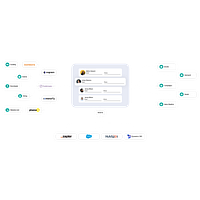
CRM migration
Field-level mapping, validation, and rollback between Sales Snap and Zoho CRM. We move data and schema; workflows are rebuilt natively in Zoho CRM.

Sales Snap
Source
Zoho CRM
Destination

Compatibility
8 of 10
objects map 1:1 between Sales Snap and Zoho CRM.
Complexity
BStandard
Timeline
2-4 weeks
Overview
Moving from Sales Snap to Zoho CRM is a manual-export-first migration because Sales Snap publishes no REST API or bulk data endpoint. All source data must be retrieved as CSV files directly from the Sales Snap UI, which means pagination limits, attachment gaps, and the absence of programmatic reconciliation are structural constraints we scope around. We extract Contacts, Company records, Sequences (as template documentation only), Tasks, and engagement history, then map them into Zoho's standard modules (Leads, Contacts, Accounts, Deals, Tasks, Events) using the Zoho Data Migration wizard or direct CSV import. The key migration risk is data completeness on the source side; we inventory every visible field in the export UI during discovery and flag any hidden or programmatically gated fields before import begins. We do not migrate Sequences as active automations, and we do not migrate file attachments stored in Sales Snap.
Every standard and custom field arrives verified.
AI proposes the map; you confirm before any record moves.
Parent–child, lookups, and ownership stay linked.
Calls, emails, meetings — with original timestamps.
Documents, uploads, and inline notes move with the record.
Why teams make this switch
Leaving
What's pushing teams away
Choosing
What's pulling them in
Object mapping
Each row shows how a Sales Snap object lands in Zoho CRM, including any object-level transformations, lookup resolution, or schema-design dependencies.
Typical mapping — final map is confirmed during the sample migration step.
Sales Snap
Contact
Zoho CRM
Lead or Contact (split based on lifecycle stage)
1:manySales Snap Contacts with lifecycle stage values indicating an unqualified prospect map to Zoho Lead. Contacts with lifecycle stage indicating a qualified buyer, active customer, or evangelist map to Zoho Contact attached to an Account. We infer the split from the lifecycle stage values visible in the CSV export and preserve the original Sales Snap lifecycle stage in a custom field snap_original_stage__c on both Lead and Contact for post-migration audit. This mapping requires the customer to confirm their lifecycle stage taxonomy during scoping since Sales Snap does not publish a standard schema.
Sales Snap
Company
Zoho CRM
Account
1:1Sales Snap Company records map to Zoho CRM Accounts. The Company Name field becomes the Account Name, and any domain or website field maps to Account Site or Website. We deduplicate on Account Name during import because Sales Snap exports Companies per-contact, which may duplicate records across multiple exported rows. We apply a fuzzy-match dedupe threshold of 95% string similarity before insert to avoid duplicate Account creation.
Sales Snap
Deal
Zoho CRM
PotentialDeals
1:1Sales Snap does not expose a standalone Deal object in exports; deal values and stages are typically embedded in contact lifecycle data or in separate deal exports if available. We map any standalone deal records to Zoho PotentialDeals. Stage values map to Zoho Stage Name, and deal amount maps to Amount. If Sales Snap exports include pipeline stage labels, we map them to Zoho Sales Stages or create custom stage values during import configuration.
Sales Snap
Sequence/Outbound Campaign
Zoho CRM
Workflow (template documentation only)
lossySales Snap Sequences cannot migrate as active automations because Zoho uses a different workflow execution model (Blueprints, assignment rules, and Deluge scripts). We document the sequence as a written template: step order, email template subject lines, personalization tokens, delay rules, and trigger conditions. The customer's Zoho admin rebuilds each sequence using Zoho's Workflow Rules or Blueprint designer post-migration. Personalization tokens require manual reconfiguration because Sales Snap tokens are not compatible with Zoho's token syntax.
Sales Snap
Task
Zoho CRM
Tasks
1:1Sales Snap Tasks map directly to Zoho Tasks. Task Subject, Due Date, Status, Priority, and Description fields migrate 1:1. Task Owner maps by email match to a Zoho User. Orphaned tasks (tasks linked to a deleted or unmapped Contact) are flagged in the reconciliation report and held in a Zoho staging module for the admin to reparent or close.
Sales Snap
Activity: Call
Zoho CRM
Calls
1:1Sales Snap call engagement logs map to Zoho Calls. Call duration, disposition, direction (inbound/outbound), and timestamp migrate to Zoho Call fields. The related Contact or Lead WhoId is resolved by email lookup during import. Call recordings are not included in Sales Snap CSV exports and are flagged as a data gap in the scoping report.
Sales Snap
Activity: Email
Zoho CRM
Email Messages (via Tasks)
1:1Sales Snap email engagement records (opens, clicks, replies, sent logs) map to Zoho Tasks with a custom activity type field. The email subject, timestamp, and engagement type (opened, clicked, replied) are preserved. Full email body content migrates to the Task Description field. We do not migrate email content as Zoho Email Messages because the Zoho Data Migration wizard does not support that object via standard CSV import; the customer can enable email logging via Zoho Mail integration post-migration if full email history is required.
Sales Snap
Activity: Meeting
Zoho CRM
Events
1:1Sales Snap meeting engagements map to Zoho Events. Event Subject, Start DateTime, End DateTime, Location, and Description migrate 1:1. Attendee emails map to Event Participants (WhoIds) via email lookup to Zoho Contacts and Leads. We create Event Relation records for each attendee during import.
Sales Snap
Custom Field
Zoho CRM
Custom Field
1:1Sales Snap custom fields visible in the CSV export map to Zoho custom fields of equivalent type. We flag any field type mismatches during the mapping phase: date fields that export as text strings require type conversion before Zoho import; picklist values require matching against Zoho's picklist options. Fields not visible in the export UI are flagged as hidden and cannot be mapped without manual discovery through Sales Snap support.
Sales Snap
Owner
Zoho CRM
User
1:1Sales Snap Owners (assigned users on Contacts, Companies, Tasks) map to Zoho Users by email address match. We extract the distinct Owner list from all exported records and match against the destination Zoho User table. Owners without a matching Zoho User are placed in a reconciliation queue; the customer's Zoho admin provisions the missing Users before record import resumes.
| Sales Snap | Zoho CRM | Compatibility | |
|---|---|---|---|
| Contact | Lead or Contact (split based on lifecycle stage)1:many | Fully supported | |
| Company | Account1:1 | Fully supported | |
| Deal | PotentialDeals1:1 | Fully supported | |
| Sequence/Outbound Campaign | Workflow (template documentation only)lossy | Fully supported | |
| Task | Tasks1:1 | Fully supported | |
| Activity: Call | Calls1:1 | Fully supported | |
| Activity: Email | Email Messages (via Tasks)1:1 | Fully supported | |
| Activity: Meeting | Events1:1 | Fully supported | |
| Custom Field | Custom Field1:1 | Fully supported | |
| Owner | User1:1 | Fully supported |
Gotchas + challenges
Platform-specific issues from each side, plus the pair-specific challenges that don't show up on either platform's page on its own.
Sales Snap gotchas
No public API for automated migration
Attachment binaries not exported in standard CSV
No documented rate limits or API quotas
Zoho CRM gotchas
API access requires Professional tier or above
Subform fields do not export cleanly via CSV
API credit consumption is non-linear
Export download links expire in 7 days
Owner (User) assignments require pre-mapped user IDs
Pair-specific challenges
Migration approach
Discovery and export coordination
We audit the Sales Snap account to identify all visible modules in the export UI: Contacts, Companies, Sequences, Tasks, and engagement logs. We guide the customer through the manual CSV export process, advising on export ordering to avoid pagination gaps. We capture a record count estimate for each module and identify any fields that appear hidden or read-only in the UI. The discovery output is a written migration scope document listing every field available for mapping, the record count per object, and any known data gaps.
Data quality audit and cleanup
We run a data quality audit on the exported CSVs before any Zoho import begins. This includes deduplication of Account records (Sales Snap exports Companies per-contact, creating duplicates), date format normalization, picklist value standardization, and identification of records with missing required Zoho fields. We produce a data quality report with a cleanup recommendation. The customer performs the actual data cleanup or engages us for a data remediation add-on. Migration does not proceed until the data quality report is reviewed and signed off.
Zoho module configuration
We configure the destination Zoho CRM modules to match the source data structure. This includes creating any custom fields not in Zoho's standard module layout, configuring Lead and Contact fields to receive the Sales Snap lifecycle stage split, setting up Account picklist options to match Sales Snap company industry values, and defining Deal stage values corresponding to Sales Snap pipeline stages. We validate the field limit (300 per module, 5 lookups) during configuration and flag any module that requires splitting across multiple Zoho modules.
Sandbox import and reconciliation
We run a trial import into a Zoho sandbox or staging environment using the cleaned CSV files. We validate field mapping, record counts, and lookup resolution (Contact-to-Account linking, Task-to-User owner assignment). The customer's admin reviews the imported records, spot-checks field values against the source CSVs, and signs off the mapping before production import begins. Any mapping corrections are made in this phase.
Production import in dependency order
We run the production migration in dependency order: Users (validated from owner email matches), Accounts (deduplicated from Company exports), Leads and Contacts (with lifecycle stage split applied and AccountId resolved), Deals, Tasks, Calls, Events, and custom field data. Each phase emits a row-count reconciliation report. The Zoho Data Migration wizard handles CSV ingestion with automatic field mapping suggestions; we validate the wizard's mapping against our documented mapping before confirming each phase.
Cutover, validation, and sequence handoff
We freeze Sales Snap as the system of record during cutover and run a final delta migration of any records modified during the migration window. We deliver the sequence template documentation to the customer's Zoho admin team for workflow rebuild. We provide a post-migration reconciliation report comparing source record counts against destination record counts and flag any residual gaps for manual resolution. We do not rebuild Sequences as Zoho workflows within the standard migration scope; that is a separate engagement or an internal admin task.
Platform deep dives
Sales Snap
Source
Strengths
Weaknesses
Zoho CRM
Destination
Strengths
Weaknesses
Complexity grading
Standard CRM migration. 1 of 8 objects need a mapping; the rest are 1:1.
Overall complexity
Standard migration
Derived from compatibility, mapping clarity, API constraints, and data volume across Sales Snap and Zoho CRM.
Object compatibility
1 of 8 objects need a mapping; the rest are 1:1.
Field mapping clarity
Field mapping is derived from defaults — final spec confirmed during the sample migration.
Timeline complexity
8-object category — typical timelines run 2–7 days end-to-end.
API constraints
Sales Snap: No public API.
Data volume sensitivity
Sales Snap doesn't expose a bulk API — REST + parallelization used for high-volume runs.
Estimator
Rule-based pricing — no per-record fees, no manual quotes. Migrations over 2M records are scoped individually.
Step 1
Pick a category, then your source and destination platforms.
Category
FAQ
Answers to the questions buyers ask most during Sales Snap to Zoho CRM migration scoping. Not seeing yours? Book a call.
Walk through your Sales Snap to Zoho CRM migration with a real engineer — 30 minutes, free, written quote within 24 hours.
Book a free 30 minute consultationAdjacent paths
Other ways to leave Sales Snap









Other ways to arrive at Zoho CRM
Popular CRM migrations


Ready when you are
Tell us record counts and timeline. We'll come back with a written quote inside 1 business day — no commitment, no sales pitch.