CRM migration
Field-level mapping, validation, and rollback between Aweber and Salesforce Sales Cloud. We move data and schema; workflows are rebuilt natively in Salesforce Sales Cloud.

Aweber
Source
Salesforce Sales Cloud
Destination

Compatibility
11 of 12
objects map 1:1 between Aweber and Salesforce Sales Cloud.
Complexity
BStandard
Timeline
24–72 hours
Overview
AWeber is an email service provider (ESP) — its data model centers on Subscribers, Lists, Tags, Custom Fields, Campaigns, and Automations. Salesforce Sales Cloud is a CRM with Contacts, Leads, Accounts, Opportunities, Campaigns, Tasks, and custom objects. This migration maps subscriber records to Salesforce Contacts or Leads, preserves list membership as Campaign Member records, and migrates custom fields as Salesforce custom fields on the Contact object. Engagement activity (opens, clicks, last-click date) is stored as custom fields for reporting continuity. AWeber automations — email sequences, wait-step campaigns, and behavioral triggers — have no direct Salesforce equivalent and must be rebuilt in Salesforce Flow. FlitStack AI sequences the migration using AWeber's REST API (120 requests per minute) or CSV export, resolves owners by email match, and delivers a sample migration with field-level diff before committing the full run. Custom field count, tag volume, and engagement-history depth are the primary cost drivers.
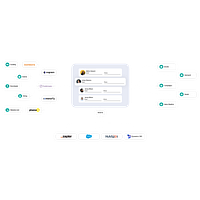
Every standard and custom field arrives verified.
AI proposes the map; you confirm before any record moves.
Parent–child, lookups, and ownership stay linked.
Calls, emails, meetings — with original timestamps.
Documents, uploads, and inline notes move with the record.
Why teams make this switch
Leaving
What's pushing teams away
Choosing
What's pulling them in
Object mapping
Each row shows how a Aweber object lands in Salesforce Sales Cloud, including any object-level transformations, lookup resolution, or schema-design dependencies.
Typical mapping — final map is confirmed during the sample migration step.
Aweber
Subscriber
Salesforce Sales Cloud
Contact
1:1AWeber subscribers map 1:1 to Salesforce Contacts. Each subscriber record — including email, name, custom fields, and tags — becomes one Contact record. Owner resolution is performed by matching the subscriber's email (or designated owner field) against Salesforce User emails. Unmatched owners are flagged before migration runs and assigned to a configurable fallback user or queue.
Aweber
Subscriber (unconverted / early-stage)
Salesforce Sales Cloud
Lead
1:manySubscribers who have not purchased or engaged beyond a threshold can route to Salesforce Leads instead of Contacts. Your team defines the split criteria (e.g., has_purchased flag, tag presence) before migration. Leads and Contacts share the same custom field schema for consistent reporting across both objects.
Aweber
Company name (custom field or name field)
Salesforce Sales Cloud
Account
1:1AWeber does not have a native Company object — company data lives in a subscriber custom field. FlitStack extracts all unique company values, applies your chosen deduplication rules (case-insensitive, trimmed), creates Account records in batch, and then links each Contact to its Account via AccountId lookup after the Account batch completes.
Aweber
List
Salesforce Sales Cloud
Campaign
1:1Each AWeber list becomes one Salesforce Campaign record. The Campaign Name maps from the AWeber list name. Campaign Type is set to 'Email' by default unless you specify a different type. List-level statistics (subscriber count, creation date) are stored as Campaign custom fields for pre- and post-migration reconciliation.
Aweber
List membership
Salesforce Sales Cloud
CampaignMember
1:1AWeber's subscriber-to-list association maps to Salesforce CampaignMember records. Each membership creates one CampaignMember linking the Contact to the Campaign. Member Status values (e.g., 'Subscribed', 'Unsubscribed') are mapped to Salesforce's MemberStatus pick-list or a custom pick-list if your status values exceed Salesforce's default options.
Aweber
Tag
Salesforce Sales Cloud
Custom pick-list or multi-select field on Contact
1:1Tags with fewer than 200 unique values map to a Contact custom pick-list field (Tag__c). Tags exceeding 1,000 unique values require a custom multi-select text field since Salesforce pick-lists cap at 1,000 values. Overflow tags are flagged before migration so your team can decide on grouping or collapse rules.
Aweber
Custom field (per subscriber)
Salesforce Sales Cloud
Custom field on Contact
1:1AWeber's per-subscriber custom fields (up to 25) map to Salesforce Contact custom fields with the __c suffix. Field type is preserved where possible: text to Text, number to Number, date to Date, dropdown to Picklist. A custom field mapping plan detailing each field pair is delivered before migration runs for Salesforce admin approval.
Aweber
Email engagement metrics (open_count, click_count, last_open, last_click)
Salesforce Sales Cloud
Custom fields on Contact
1:1AWeber tracks engagement per subscriber but Salesforce has no native equivalent for email engagement data on Contact records. These four metrics are stored as custom Number or Date fields on Contact (e.g., Aweber_Last_Click__c, Aweber_Click_Count__c) for reporting continuity. Custom field creation and population are included in the migration scope.
Aweber
Campaign / Automation (email sequence logic)
Salesforce Sales Cloud
Salesforce Flow (rebuild reference)
1:1AWeber's automation sequences, wait-step logic, and behavioral triggers have no Salesforce equivalent. FlitStack exports the full automation structure (trigger conditions, wait durations, email send actions) as a structured reference document. Rebuilding in Salesforce Flow is a separate scope quoted by your Salesforce admin or FlitStack's Flow services team.
Aweber
Email template
Salesforce Sales Cloud
Salesforce Files or Document
1:1AWeber HTML email templates are exported as files and re-uploaded to Salesforce Files. Salesforce does not have a native email template library for Contacts — templates are typically managed in Salesforce Content, Files, or your email integration tool (e.g., Salesforce Inbox, Gmail integration).
Aweber
Signup form
Salesforce Sales Cloud
Web-to-Lead / Form Assembly
1:1AWeber sign-up forms are platform-native and cannot be exported. FlitStack documents the form field mapping, conditional logic, and integration settings as a rebuild reference for Salesforce Web-to-Lead or a third-party form tool (FormAssembly, Typeform). Landing pages and form host pages require a separate rebuild in your chosen platform.
Aweber
Subscriber system ID
Salesforce Sales Cloud
Custom field on Contact
1:1AWeber's internal subscriber ID is preserved as a custom text field (Aweber_Subscriber_ID__c) on the Contact record. This serves as the source-system anchor for delta-run de-duplication and for linking back to AWeber data during the delta-pickup window to ensure no subscribers are missed or duplicated.
| Aweber | Salesforce Sales Cloud | Compatibility | |
|---|---|---|---|
| Subscriber | Contact1:1 | Fully supported | |
| Subscriber (unconverted / early-stage) | Lead1:many | Fully supported | |
| Company name (custom field or name field) | Account1:1 | Fully supported | |
| List | Campaign1:1 | Fully supported | |
| List membership | CampaignMember1:1 | Fully supported | |
| Tag | Custom pick-list or multi-select field on Contact1:1 | Fully supported | |
| Custom field (per subscriber) | Custom field on Contact1:1 | Fully supported | |
| Email engagement metrics (open_count, click_count, last_open, last_click) | Custom fields on Contact1:1 | Fully supported | |
| Campaign / Automation (email sequence logic) | Salesforce Flow (rebuild reference)1:1 | Fully supported | |
| Email template | Salesforce Files or Document1:1 | Fully supported | |
| Signup form | Web-to-Lead / Form Assembly1:1 | Fully supported | |
| Subscriber system ID | Custom field on Contact1:1 | Fully supported |
Gotchas + challenges
Platform-specific issues from each side, plus the pair-specific challenges that don't show up on either platform's page on its own.
Aweber gotchas
120 req/min API rate limit blocks bulk exports at scale
Auto-upgrade billing without auto-downgrade
API subscriber moves lose custom field values when field names diverge
Automation and Workflow logic has no export path
Custom fields are list-scoped, not global across account
Salesforce Sales Cloud gotchas
Workflow Rules and Process Builder are retired
Bulk API batch quota exhaustion during large imports
Storage overage billing is non-obvious
Account-Contact many-to-many relationship mapping
Territory and team member import ordering dependencies
Pair-specific challenges
Migration approach
Extract AWeber subscriber data via REST API
FlitStack connects to your AWeber account using OAuth2 and pulls all subscriber records via the /accounts/{id}/subscribers endpoint. Each record is retrieved with its custom field values, tag list, and engagement metrics (open_count, click_count, last_open, last_click). Lists are pulled as separate collections. AWeber's 120 requests per minute rate limit is respected throughout extraction — large accounts use a paginated batch approach. Subscribers are exported in JSON format for field-level mapping before transformation.
Design Salesforce schema and custom fields
Before any data is loaded, FlitStack delivers a Salesforce schema setup plan based on your AWeber data inventory. This includes: (1) custom fields on Contact for engagement metrics and source-system IDs, (2) a Tag__c pick-list or multi-select field, (3) Campaign records to be created from your AWeber lists, and (4) a company-deduplication and Account creation plan. Your Salesforce admin creates these fields (or FlitStack creates them in a sandbox first). No data loads until the schema is confirmed.
Resolve owners and company relationships
AWeber has no owner concept — Salesforce Contacts require an OwnerId. FlitStack resolves each subscriber's owner by matching the subscriber's email (or a designated owner email field) against Salesforce User emails. Unmatched owners are flagged before migration and assigned to a configurable fallback user or queue. Company values are extracted, deduplicated using your chosen normalization rule (case-insensitive, trimmed), and Account records are created in batch before contacts are linked via AccountId.
Run sample migration with field-level diff
A representative slice of 100–500 subscriber records migrates first — covering multiple AWeber lists, a range of custom field types, and a sample of tagged and untagged records. FlitStack generates a field-level diff comparing source (AWeber JSON) against destination (Salesforce Contact fields) so you can verify engagement metric mapping, tag-to-pick-list resolution, company-to-Account linkage, and owner resolution. You approve the sample before the full run commits. Any field mapping corrections are applied to the full migration plan.
Full migration with delta-pickup window
The full subscriber batch is loaded into Salesforce using the Bulk API for high-volume runs or the REST API for smaller accounts. Lists are created as Campaign records and subscriber-to-list membership is inserted as CampaignMember records. A delta-pickup window (24–48 hours) runs after the initial batch, capturing any subscribers who were added or modified in AWeber during the migration window. AWeber remains in read-only access during this period — no sends are affected. FlitStack provides an audit log of every record inserted, updated, or skipped, plus a de-duplication report if any subscriber IDs conflict.
Platform deep dives
Aweber
Source
Strengths
Weaknesses
Salesforce Sales Cloud
Destination
Strengths
Weaknesses
Complexity grading
Standard CRM migration. 2 of 8 objects need a mapping; the rest are 1:1.
Overall complexity
Standard migration
Derived from compatibility, mapping clarity, API constraints, and data volume across Aweber and Salesforce Sales Cloud.
Object compatibility
2 of 8 objects need a mapping; the rest are 1:1.
Field mapping clarity
Field mapping is derived from defaults — final spec confirmed during the sample migration.
Timeline complexity
8-object category — typical timelines run 2–7 days end-to-end.
API constraints
Aweber: 120 requests per minute per account; no daily or monthly caps.
Data volume sensitivity
Aweber doesn't expose a bulk API — REST + parallelization used for high-volume runs.
Estimator
Rule-based pricing — no per-record fees, no manual quotes. Migrations over 2M records are scoped individually.
Step 1
Pick a category, then your source and destination platforms.
Category
FAQ
Answers to the questions buyers ask most during Aweber to Salesforce Sales Cloud migration scoping. Not seeing yours? Book a call.
Walk through your Aweber to Salesforce Sales Cloud migration with a real engineer — 30 minutes, free, written quote within 24 hours.
Book a free 30 minute consultationAdjacent paths
Other ways to leave Aweber
Other ways to arrive at Salesforce Sales Cloud








Popular CRM migrations









Ready when you are
Tell us record counts and timeline. We'll come back with a written quote inside 1 business day — no commitment, no sales pitch.

