CRM migration
Field-level mapping, validation, and rollback between Mekari Qontak and HighLevel. We move data and schema; workflows are rebuilt natively in HighLevel.

Mekari Qontak
Source
HighLevel
Destination

Compatibility
5 of 9
objects map 1:1 between Mekari Qontak and HighLevel.
Complexity
BStandard
Timeline
2-4 weeks
Overview
Mekari Qontak is an Indonesia-centric omnichannel CRM built around the WhatsApp Business API, pairing a centralized messaging inbox with embedded CRM and ticket management for Southeast Asian teams. GoHighLevel is a global all-in-one agency CRM that consolidates CRM, marketing automation, pipeline management, and customer portals into a single platform used by over 80,000 agencies and SMBs. The migration path from Qontak to GoHighLevel is primarily driven by teams outgrowing Indonesian-Rupiah pricing, daily broadcast quota limits, and limited public API documentation. We extract Contacts, Companies, Deals, and Tickets from Qontak via the Mekari API, map Qontak pipeline stages and ticket status values to GoHighLevel opportunity stages and pipeline statuses, and sequence the WhatsApp number offboarding before the contact export runs so that conversation history remains accessible during migration. Chatbot flows, workflow automations, and approved WhatsApp Templates do not migrate; we document these for the customer to rebuild in GoHighLevel's automation builder.
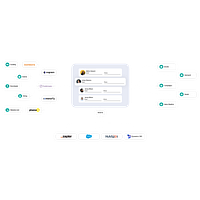
Every standard and custom field arrives verified.
AI proposes the map; you confirm before any record moves.
Parent–child, lookups, and ownership stay linked.
Calls, emails, meetings — with original timestamps.
Documents, uploads, and inline notes move with the record.
Why teams make this switch
Leaving
What's pushing teams away
Choosing
What's pulling them in
Object mapping
Each row shows how a Mekari Qontak object lands in HighLevel, including any object-level transformations, lookup resolution, or schema-design dependencies.
Typical mapping — final map is confirmed during the sample migration step.
Mekari Qontak
Contact
HighLevel
Contact
1:1Qontak Contacts map directly to GoHighLevel Contacts. Standard fields (name, phone, email, address) map to their GoHighLevel equivalents. Custom Contact properties from Qontak map to GoHighLevel Contact custom fields, with data type conversion applied: Qontak multi-select picklist properties become GoHighLevel multi-select custom fields, date properties map to GoHighLevel date fields, and numeric properties map to GoHighLevel number fields. Phone number field is used as the dedupe key during import to prevent duplicate contacts.
Mekari Qontak
Company
HighLevel
Company
1:1Qontak Company records map to GoHighLevel Companies. The Qontak company name becomes the Company name field, domain becomes Website, and associated custom properties migrate to GoHighLevel Company custom fields. Qontak's company type and industry enumerated fields map to GoHighLevel picklist fields with the same value sets.
Mekari Qontak
Deal
HighLevel
Opportunity
1:1Qontak Deals map to GoHighLevel Opportunities. The Qontak pipeline and dealstage map to a GoHighLevel pipeline and stage. We create the GoHighLevel pipeline stages before migration to match the Qontak stage names and probabilities. Deal value, close date, and associated contacts migrate as Opportunity fields. Any Qontak deal custom properties map to GoHighLevel Opportunity custom fields.
Mekari Qontak
Ticket
HighLevel
Task
1:1Qontak Tickets map to GoHighLevel Tasks using a dedicated migration mode that maps ticket fields to Task fields: ticket subject becomes Task name, ticket description becomes Task body, Qontak ticket status (Open, In Progress, Resolved) maps to GoHighLevel Task status values, and priority maps to Task priority. If the customer uses GoHighLevel's native ticketing feature, we map to that object instead and create the ticket status pipeline before import.
Mekari Qontak
Contact List / Segment
HighLevel
Contact / Tag
1:manyQontak static contact lists and dynamic segments require two handling paths. Static list membership migrates as a Tag on each GoHighLevel Contact, preserving the list name as the tag value. Dynamic segment membership recalculates in GoHighLevel based on current Contact field values; we export the segment definition (filter criteria) as a written document for the customer to recreate using GoHighLevel's Smart List filters.
Mekari Qontak
User / Agent
HighLevel
User / Contact
lossyQontak agent records (Supervisor, Agent roles with channel allocation rules) map to GoHighLevel Users for active agents. We resolve by email match. Any Qontak agent without a matching GoHighLevel User is held in a reconciliation queue for the customer's admin to provision. Qontak role hierarchy and channel allocation rules are documented as a written spec for manual recreation in GoHighLevel team settings.
Mekari Qontak
Custom Property
HighLevel
Custom Field
1:1Qontak custom Contact and Deal properties migrate to GoHighLevel Contact custom fields and Opportunity custom fields respectively. We extract the full custom property schema from Qontak at scan time, match each property to the correct GoHighLevel custom field type (text, number, date, picklist, multi-select), and pre-create the GoHighLevel custom fields before data import begins.
Mekari Qontak
Chatbot Flow
HighLevel
Workflow (documentation only)
lossyQontak chatbot flows use a proprietary JSON schema that is not portable to GoHighLevel's automation builder. We extract the full decision tree structure, trigger conditions, message content, and conditional branching logic as a detailed flow map document. GoHighLevel's Workflow builder is the recommended rebuild target. The flow map includes recommended trigger equivalents, action blocks, and delay sequences that map to GoHighLevel's visual automation model.
Mekari Qontak
WhatsApp Template
HighLevel
WhatsApp Template (re-approval required)
lossyApproved WhatsApp message templates are tied to the Qontak-hosted WABA account and cannot be transferred directly to GoHighLevel. We document all approved templates (header, body, footer, buttons, variables) from the Qontak WABA. The customer must register a new WhatsApp Business API number in GoHighLevel (or port the existing number if eligible) and submit templates for WhatsApp re-approval through the GoHighLevel-connected Meta Business Manager.
| Mekari Qontak | HighLevel | Compatibility | |
|---|---|---|---|
| Contact | Contact1:1 | Fully supported | |
| Company | Company1:1 | Fully supported | |
| Deal | Opportunity1:1 | Fully supported | |
| Ticket | Task1:1 | Fully supported | |
| Contact List / Segment | Contact / Tag1:many | Fully supported | |
| User / Agent | User / Contactlossy | Fully supported | |
| Custom Property | Custom Field1:1 | Fully supported | |
| Chatbot Flow | Workflow (documentation only)lossy | Fully supported | |
| WhatsApp Template | WhatsApp Template (re-approval required)lossy | Fully supported |
Gotchas + challenges
Platform-specific issues from each side, plus the pair-specific challenges that don't show up on either platform's page on its own.
Mekari Qontak gotchas
WhatsApp Business API number offboarding requires manual support request
Broadcast quotas are enforced at account level, not campaign level
Marketing Messages API migration for WABA numbers registered after August 2025
Chatbot flow JSON is not portable between platforms
Frequent platform UI updates can rename or relocate export options
HighLevel gotchas
Sub-account architecture creates isolated data silos per client
Usage-based telecom and AI costs are not in the subscription price
Workflows have no native equivalent in most destination CRMs
API rate limits cap bulk migration throughput at 100 requests per 10 seconds per sub-account
White-label configuration and branding assets do not export via API
Pair-specific challenges
Migration approach
Discovery and scope definition
We audit the source Qontak account across plan tier (Omnichannel Starter, Sales Suite, Service Suite, Qontak 360), API availability, custom property schema for Contacts and Deals, active pipeline count and stage names, ticket status values, WhatsApp Business API number status, broadcast quota headroom, and engagement volume. We pair this with a GoHighLevel account review of custom field setup and pipeline configuration. The discovery output is a written migration scope, object mapping document, and WhatsApp offboarding coordination plan.
WhatsApp Business API offboarding coordination
We submit the WABA offboarding request to [email protected] on the customer's behalf before any data export begins. We sequence the contact export and conversation history export to complete before the offboarding is confirmed, ensuring message history remains accessible via the Qontak API. We document all approved WhatsApp message templates during this window so they can be re-submitted for approval in GoHighLevel after the new WABA is registered.
GoHighLevel schema setup
We create the GoHighLevel pipelines and stages to match the Qontak pipeline and dealstage names. We pre-create all Contact custom fields and Opportunity custom fields with correct data types (text, number, date, picklist, multi-select) before any data import. If the customer uses GoHighLevel's native ticketing feature, we create the ticket status pipeline here. We set up the GoHighLevel SMTP or Twilio integration for messaging to replace Qontak's broadcast infrastructure.
Data extraction and transformation
We extract Contacts, Companies, Deals, Tickets, and Contact Lists from Qontak via the Mekari API. We apply the transformation pipeline: Qontak lifecycle and role properties map to GoHighLevel Contact tags and custom fields; Qontak dealstage and pipeline map to GoHighLevel Opportunity stage and pipeline; Qontak ticket status maps to GoHighLevel Task status. We apply quota-aware chunking to large contact batches to avoid triggering Qontak's daily broadcast limit mid-export.
Sandbox migration and reconciliation
We run a full migration into a GoHighLevel test location or sub-account using production-like data volume. The customer's operations lead reconciles record counts (Contacts in, Companies in, Deals in, Tickets in), spot-checks 20-30 random records against the Qontak source, and validates custom field values and pipeline stage assignments. Mapping corrections happen in the test environment before production migration begins.
Production migration in dependency order
We run production migration in record-dependency order: Companies first (to satisfy the Company lookup on Contacts), then Contacts with tags and custom fields, then Deals mapped to Opportunities with stage assignments, then Tickets mapped to Tasks or native ticketing, then Contact Lists converted to GoHighLevel Tags. Each phase emits a row-count reconciliation report before the next phase begins.
Cutover, validation, and automation rebuild handoff
We freeze Qontak writes during the cutover window, run a final delta migration of any records modified during the migration, then mark GoHighLevel as the active system of record. We deliver the chatbot flow map and automation rebuild documentation to the customer for recreation in GoHighLevel's Workflow builder. We provide a one-week hypercare window for reconciliation issues. We do not rebuild Qontak workflows or chatbot flows as GoHighLevel automations inside the migration scope.
Platform deep dives
Mekari Qontak
Source
Strengths
Weaknesses
HighLevel
Destination
Strengths
Weaknesses
Complexity grading
Standard CRM migration. 2 of 8 objects need a mapping; the rest are 1:1.
Overall complexity
Standard migration
Derived from compatibility, mapping clarity, API constraints, and data volume across Mekari Qontak and HighLevel.
Object compatibility
2 of 8 objects need a mapping; the rest are 1:1.
Field mapping clarity
Field mapping is derived from defaults — final spec confirmed during the sample migration.
Timeline complexity
8-object category — typical timelines run 2–7 days end-to-end.
API constraints
Mekari Qontak: Not publicly documented by Qontak; enforced at account level for broadcast quotas.
Data volume sensitivity
Mekari Qontak doesn't expose a bulk API — REST + parallelization used for high-volume runs.
Estimator
Rule-based pricing — no per-record fees, no manual quotes. Migrations over 2M records are scoped individually.
Step 1
Pick a category, then your source and destination platforms.
Category
FAQ
Answers to the questions buyers ask most during Mekari Qontak to HighLevel migration scoping. Not seeing yours? Book a call.
Walk through your Mekari Qontak to HighLevel migration with a real engineer — 30 minutes, free, written quote within 24 hours.
Book a free 30 minute consultationAdjacent paths
Other ways to leave Mekari Qontak









Other ways to arrive at HighLevel
Popular CRM migrations


Ready when you are
Tell us record counts and timeline. We'll come back with a written quote inside 1 business day — no commitment, no sales pitch.