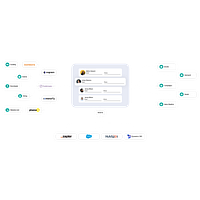
CRM migration
Field-level mapping, validation, and rollback between OptifiNow and HubSpot. We move data and schema; workflows are rebuilt natively in HubSpot.

OptifiNow
Source
HubSpot
Destination

Compatibility
12 of 12
objects map 1:1 between OptifiNow and HubSpot.
Complexity
BStandard
Timeline
48–72 hours
Overview
OptifiNow is an enterprise sales and marketing platform built around configurable sales processes, lead routing, and marketing automation. Its data model centers on Leads, Contacts, Accounts, Opportunities, and a workflow engine that orchestrates multi-stage sequences. The platform stores custom properties per object and exposes an API for integrations, though documentation on export endpoints is limited — teams typically need white-glove support to extract a complete dataset. HubSpot CRM uses a flat properties model for Contacts and Companies, lifecycle_stage as the primary lead progression signal, and a Sales pipeline model with deal stages tied to individual pipelines. The two platforms share a Contacts-Accounts-Opportunities structure, but OptifiNow's named lifecycle stages and sequence-based automation have no direct HubSpot equivalent. FlitStack AI reads from OptifiNow's API using scoped credentials, extracts all standard and custom object records in batches, and maps them into HubSpot's Contact, Company, and Deal objects via HubSpot's Contacts API or CSV import. OptifiNow workflows and sequences cannot migrate — we document the existing workflow definitions as a rebuild reference for your HubSpot admin. Files attached to records are re-uploaded to HubSpot Files. A 24–48 hour delta pickup window captures any records created or updated in OptifiNow during the cutover period.
Every standard and custom field arrives verified.
AI proposes the map; you confirm before any record moves.
Parent–child, lookups, and ownership stay linked.
Calls, emails, meetings — with original timestamps.
Documents, uploads, and inline notes move with the record.
Why teams make this switch
Leaving
What's pushing teams away
Choosing
What's pulling them in
Object mapping
Each row shows how a OptifiNow object lands in HubSpot, including any object-level transformations, lookup resolution, or schema-design dependencies.
Typical mapping — final map is confirmed during the sample migration step.
OptifiNow
Lead
HubSpot
Contact
1:1OptifiNow Leads migrate as HubSpot Contacts. HubSpot uses lifecycle_stage as the progression property — we set the initial lifecycle_stage value based on OptifiNow's lead status field during the mapping phase. Original owner assignments resolve by email match to HubSpot users.
OptifiNow
Contact
HubSpot
Contact
1:1Direct 1:1 map. HubSpot's Contact object holds all standard contact properties (name, email, phone, address). If the OptifiNow contact has no associated Account, it lands in HubSpot as a Contact without a Company association — a default placeholder company can be assigned or left unlinked per your rule.
OptifiNow
Account
HubSpot
Company
1:1OptifiNow Accounts map directly to HubSpot Companies. Company name, domain, industry, employee count, and annual revenue fields migrate to HubSpot's standard Company properties. Parent-account hierarchies in OptifiNow translate to HubSpot's parent company association on the Company record. All account associations are preserved during migration to maintain your organizational data relationships intact.
OptifiNow
Opportunity
HubSpot
Deal
1:1OptifiNow Opportunities map to HubSpot Deals. Each OptifiNow deal carries a pipeline name and stage; we translate these to HubSpot's Sales pipeline model, creating a HubSpot pipeline with matching stage names. Deal amount, close date, owner, and custom properties move to HubSpot Deal fields.
OptifiNow
Pipeline
HubSpot
Sales pipeline
1:1OptifiNow pipelines are named configurations that define the available stages for Opportunities within a team or business unit. Each OptifiNow pipeline becomes a separate HubSpot Sales pipeline. Stage order and names map 1:1; if HubSpot's default stages don't match, we add custom stage names to the target pipeline before the deal migration runs.
OptifiNow
Lead stage / status
HubSpot
lifecycle_stage (custom property)
1:1OptifiNow's named lead stages (Lead, Prospect, Nurture, Qualification, etc.) have no direct HubSpot equivalent because HubSpot uses a fixed lifecycle_stage pick-list. We create a Lifecycle_Stage__c custom property on the Contact object and map OptifiNow's stage names to the closest HubSpot lifecycle_stage value — unrecognized stages default to 'Lead' and are flagged for your admin to confirm.
OptifiNow
Activity / engagement log
HubSpot
Engagement (email, call, meeting)
1:1OptifiNow engagement records — calls, emails, meetings, and notes tied to a contact or opportunity — migrate as HubSpot Engagements. HubSpot Engagements carry the original timestamp, owner, and a link back to the parent Contact or Deal. Inline attachments in notes are downloaded and re-uploaded to HubSpot Files.
OptifiNow
Custom property (object-level)
HubSpot
Custom property on target object
1:1OptifiNow custom properties on Leads, Contacts, Accounts, and Opportunities require HubSpot custom properties to be created before data loads. We create the custom properties via HubSpot's API during the schema setup phase, using the OptifiNow property type to infer the correct HubSpot field type (string, number, date, picklist, etc.).
OptifiNow
Workflow / sequence
HubSpot
No equivalent — rebuild required
1:1OptifiNow workflows and multi-step sequences define outreach logic, time delays, and branching rules that cannot be imported into HubSpot. FlitStack AI exports the workflow definitions and sequence step data as a structured document your HubSpot admin uses to rebuild the logic in HubSpot workflows and sequences.
OptifiNow
Custom integrations (VOIP, LOS, pricing engine)
HubSpot
No equivalent — rebuild required
1:1OptifiNow integrations built for specific verticals (VOIP call matching, LOS pipeline triggers, pricing engine hooks) are proprietary API builds scoped per-customer. HubSpot's App Marketplace and API layer provide the foundation for rebuilding these connections, but the integrations themselves do not migrate.
OptifiNow
Content / document library
HubSpot
HubSpot Files + Marketing assets
1:1OptifiNow content management assets — sales collateral, templates, and media files — migrate to HubSpot Files. We download the full content library from OptifiNow and re-upload to HubSpot Files, preserving file names and folder structure where it exists. Content associations to deals or contacts are preserved as metadata.
OptifiNow
User / owner
HubSpot
HubSpot user
1:1OptifiNow users and owners resolve to HubSpot users by email address match. Unmatched owners are flagged before migration — your team either creates HubSpot user accounts first or assigns the records to a designated fallback owner. This is critical because HubSpot Deals require a valid OwnerId on every record.
| OptifiNow | HubSpot | Compatibility | |
|---|---|---|---|
| Lead | Contact1:1 | Fully supported | |
| Contact | Contact1:1 | Fully supported | |
| Account | Company1:1 | Fully supported | |
| Opportunity | Deal1:1 | Fully supported | |
| Pipeline | Sales pipeline1:1 | Fully supported | |
| Lead stage / status | lifecycle_stage (custom property)1:1 | Fully supported | |
| Activity / engagement log | Engagement (email, call, meeting)1:1 | Fully supported | |
| Custom property (object-level) | Custom property on target object1:1 | Fully supported | |
| Workflow / sequence | No equivalent — rebuild required1:1 | Fully supported | |
| Custom integrations (VOIP, LOS, pricing engine) | No equivalent — rebuild required1:1 | Fully supported | |
| Content / document library | HubSpot Files + Marketing assets1:1 | Fully supported | |
| User / owner | HubSpot user1:1 | Fully supported |
Gotchas + challenges
Platform-specific issues from each side, plus the pair-specific challenges that don't show up on either platform's page on its own.
OptifiNow gotchas
Non-public API schema requires pre-migration discovery
Pricing structure includes variable overages not visible at signup
Marketing automation sequences do not export as executable logic
Limited public review corpus complicates reference checking
HubSpot gotchas
Marketing Contacts billing model is migration-critical
Feature tier gating is not visible until onboarding
Mandatory onboarding fees inflate year-one cost
HubSpot CSV importer cannot migrate engagements or attachments
Custom objects require Enterprise and a pre-existing schema
Pair-specific challenges
Migration approach
Discovery and data audit
We connect to OptifiNow using scoped API credentials and audit every object type — Leads, Contacts, Accounts, Opportunities, Engagements, and any custom properties — to understand your full data volume and schema. We surface any gaps in export coverage early and coordinate with OptifiNow support if vendor-assisted extraction is needed. The output is a data inventory document that defines the exact scope before any migration work begins.
Build HubSpot target schema
Before records move, we create the HubSpot pipelines, stage configurations, and custom properties needed to receive your OptifiNow data. If you use Enterprise-tier features like Custom Objects, we create those schema types in HubSpot and define which OptifiNow custom properties map to which object. We deliver a schema setup checklist so your HubSpot admin can review and approve the configuration before data lands.
Extract and transform OptifiNow data
OptifiNow records are extracted in batches via the API, transformed to match HubSpot's property names and types, and cleaned for formatting issues (duplicate emails, missing required fields, invalid dates). Owner assignments are resolved by email matching against HubSpot users — any unresolved owners are flagged and assigned to a fallback owner you designate. Lifecycle stage values are translated to HubSpot's fixed pick-list per the mapping plan.
Run sample migration with field-level diff
A representative slice of records — typically 100–500 covering each object type, pipeline, and owner — migrates to your HubSpot sandbox or production portal first. We generate a field-level comparison showing source vs. destination values for every mapped field so you can verify lifecycle stage translation, pipeline mapping, owner resolution, and attachment re-upload before the full run commits. This sample validation allows you to confirm data integrity and flag any mapping adjustments needed before the complete dataset runs.
Full migration with delta-pickup cutover
The full dataset loads into your HubSpot portal. A delta-pickup window of 24–48 hours captures any records created or modified in OptifiNow during the cutover period so HubSpot reflects OptifiNow's final state at go-live. All operations are logged to an audit trail; one-click rollback is available if reconciliation identifies a data integrity issue. We verify record counts, association links, and engagement timestamps post-load before sign-off.
Deliver workflow reference and post-migration handoff
We export OptifiNow workflow definitions, sequence step data, and custom integration trigger points as a structured reference document your HubSpot admin uses to rebuild automation logic in HubSpot workflows and sequences. We surface the list of active OptifiNow integrations that need to be rebuilt against HubSpot's API or App Marketplace, with a rebuild scope estimate for each. This documentation ensures your implementation team has a clear rebuild roadmap and priority sequence for each integration.
Platform deep dives
OptifiNow
Source
Strengths
Weaknesses
HubSpot
Destination
Strengths
Weaknesses
Complexity grading
Standard CRM migration. 2 of 8 objects need a mapping; the rest are 1:1.
Overall complexity
Standard migration
Derived from compatibility, mapping clarity, API constraints, and data volume across OptifiNow and HubSpot.
Object compatibility
2 of 8 objects need a mapping; the rest are 1:1.
Field mapping clarity
Field mapping is derived from defaults — final spec confirmed during the sample migration.
Timeline complexity
8-object category — typical timelines run 2–7 days end-to-end.
API constraints
OptifiNow: Not publicly documented.
Data volume sensitivity
OptifiNow doesn't expose a bulk API — REST + parallelization used for high-volume runs.
Estimator
Rule-based pricing — no per-record fees, no manual quotes. Migrations over 2M records are scoped individually.
Step 1
Pick a category, then your source and destination platforms.
Category
FAQ
Answers to the questions buyers ask most during OptifiNow to HubSpot migration scoping. Not seeing yours? Book a call.
Walk through your OptifiNow to HubSpot migration with a real engineer — 30 minutes, free, written quote within 24 hours.
Book a free 30 minute consultationAdjacent paths
Other ways to leave OptifiNow









Other ways to arrive at HubSpot
Popular CRM migrations


Ready when you are
Tell us record counts and timeline. We'll come back with a written quote inside 1 business day — no commitment, no sales pitch.