CRM migration
Field-level mapping, validation, and rollback between MaxCredible and Salesforce Sales Cloud. We move data and schema; workflows are rebuilt natively in Salesforce Sales Cloud.

MaxCredible
Source
Salesforce Sales Cloud
Destination

Compatibility
9 of 12
objects map 1:1 between MaxCredible and Salesforce Sales Cloud.
Complexity
BStandard
Timeline
2-4 weeks
Overview
Moving from MaxCredible to Salesforce is a structural and conceptual migration: MaxCredible organizes its entire data model around the Debtor, treating invoices, credit notes, reminders, and communication logs as child entities of a single receivables record, while Salesforce separates Accounts (companies), Contacts (people), and Opportunities (deals) into a relational model. We resolve that schema difference during discovery by extracting sample XML from the customer's MaxCredible instance to reverse-engineer the integration format, then map each MaxCredible object into its Salesforce equivalent. Invoices map to Opportunities with custom fields for invoice number, due date, and amount; the Receivables Ledger maps to a custom object with aging buckets; Credit Notes map to a second custom object linked to the parent Opportunity. AI risk scores migrate as snapshot values on the Account with no recalculation in scope. Tone-of-voice templates, workflow automations, and ERP integration configuration do not migrate; we deliver a written inventory of each for the customer's admin to rebuild in Salesforce.
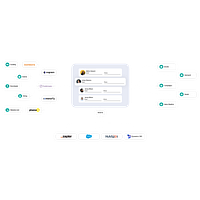
Every standard and custom field arrives verified.
AI proposes the map; you confirm before any record moves.
Parent–child, lookups, and ownership stay linked.
Calls, emails, meetings — with original timestamps.
Documents, uploads, and inline notes move with the record.
Why teams make this switch
Leaving
What's pushing teams away
Choosing
What's pulling them in
Object mapping
Each row shows how a MaxCredible object lands in Salesforce Sales Cloud, including any object-level transformations, lookup resolution, or schema-design dependencies.
Typical mapping — final map is confirmed during the sample migration step.
MaxCredible
Debtor
Salesforce Sales Cloud
Account and Contact
1:manyMaxCredible Debtors map to a Salesforce Account (the company-level record) with a primary Contact record created from the debtor's contact details. If the debtor has multiple contacts (billing, accounts receivable, legal), additional Contact records are created under the same Account. The MaxCredible debtor_id becomes the Account's external ID (maxcredible_debtor_id__c) for lookup resolution during invoice import. Credit risk score migrates as a custom field on Account (maxcredible_risk_score__c) and risk model version migrates as maxcredible_risk_model_version__c. The debtor's payment behavior summary migrates as a long-text area field for admin reference.
MaxCredible
Invoice
Salesforce Sales Cloud
Opportunity
1:1MaxCredible Invoices map to Salesforce Opportunity. The Opportunity Name uses the invoice number; Amount maps to Amount; CloseDate maps to CloseDate (set to the invoice due date); StageName is set to 'Closed Won' for paid invoices or 'Invoice Sent' for outstanding invoices based on MaxCredible's payment_status property. Invoice number migrates as a custom field (invoice_number__c); original invoice date as invoice_date__c; outstanding balance as invoice_balance__c. The Opportunity is linked to the Account resolved from the parent Debtor record.
MaxCredible
Credit Note
Salesforce Sales Cloud
Custom Object: Credit_Note__c
1:1MaxCredible Credit Notes map to a Salesforce custom object (Credit_Note__c) with a lookup to the parent Opportunity (mapped from the MaxCredible Invoice that the Credit Note adjusts). Custom object creation is included in the migration scope for Professional tier and above. Fields include: credit_note_number__c (external ID), original_invoice__c (lookup to Opportunity), credit_amount__c, issue_date__c, and status__c (open/closed). The net receivable balance is recalculated in Salesforce after both records are loaded.
MaxCredible
Reminder
Salesforce Sales Cloud
Task
1:1MaxCredible Reminders map to Salesforce Task records. The debtor reference resolves to an Account or Contact lookup; the invoice reference resolves to an Opportunity lookup. Reminder due date maps to ActivityDate; reminder body maps to Subject and Description. Status is set to Not Started for open reminders and Completed for fulfilled ones. Recurring reminder patterns are documented as a series of Tasks rather than migrated as a recurrence rule (Salesforce Tasks do not support native recurrence migration).
MaxCredible
Receivables Ledger
Salesforce Sales Cloud
Custom Object: Receivables_Ledger__c
1:1The MaxCredible receivables ledger aggregates all open items per debtor. We extract it as a structured dataset and map it to a custom Salesforce object (Receivables_Ledger__c) with fields for total_open_amount__c, oldest_open_item_date__c, days_sales_outstanding__c, and payment_terms__c. Aging buckets (current, 1-30, 31-60, 61-90, 90+) migrate as separate custom fields for dashboard reconstruction. This object is linked to the Account.
MaxCredible
Communication Log (Email)
Salesforce Sales Cloud
Task + EmailMessage
1:1MaxCredible email communication logs migrate to Salesforce EmailMessage records (body and headers) linked to a Task record on the activity timeline. The WhoId on the Task points to the Contact or Lead resolved from the debtor; WhatId points to the Account or Opportunity. Email subject maps to Task.Subject; send date maps to ActivityDate. Template references are preserved as a custom field (email_template_ref__c) in the Task record for admin reconstruction.
MaxCredible
Communication Log (SMS)
Salesforce Sales Cloud
Task
1:1MaxCredible SMS logs migrate to Salesforce Task records with TaskSubtype = SMS (if Salesforce Messaging is enabled) or a custom task type field. Carrier metadata from MaxCredible is preserved in a custom field (sms_carrier__c). SMS body migrates to Task.Description; send date maps to ActivityDate. Thread context is preserved in a custom field (sms_thread_id__c).
MaxCredible
Communication Log (WhatsApp)
Salesforce Sales Cloud
Task
1:1MaxCredible WhatsApp logs migrate to Salesforce Task records. Thread context is preserved in a custom field (whatsapp_thread_id__c). Message body migrates to Task.Description; send date maps to ActivityDate. Note that WhatsApp-specific rich context (read receipts, media attachments) is simplified in the Salesforce Task model; we flag any media attachment URLs and document them for the customer's admin to reconnect in Salesforce's native Messaging or a third-party WhatsApp integration.
MaxCredible
Risk Score
Salesforce Sales Cloud
Custom Fields on Account
1:1MaxCredible AI credit risk scores migrate as snapshot values in custom fields on the Account: maxcredible_risk_score__c (number), maxcredible_risk_effective_date__c (date), and maxcredible_risk_model_version__c (text). The underlying behavioral data (payment timing history, dispute frequency) is not separately exposed in MaxCredible's export, so the destination cannot reproduce the exact same score without access to the raw dataset. We document this limitation and recommend recalibrating credit risk models in Salesforce Data Cloud or a third-party scoring tool post-migration.
MaxCredible
Tone-of-Voice Templates
Salesforce Sales Cloud
Documentation (Salesforce Email Templates)
lossyMaxCredible tone-of-voice templates are stored as platform configuration rather than structured data. We export the template body copy and variable placeholders as a written inventory document with template name, body, variables, and usage notes. The customer's marketing or operations team rebuilds the templates in Salesforce's Email Template builder or Content Builder. This is documentation-only scope; no template records are created in Salesforce during migration.
MaxCredible
ERP Integration Configuration
Salesforce Sales Cloud
Documentation (MuleSoft/AppExchange)
lossyMaxCredible's XML-based ERP integration for Oracle and SAP uses a proprietary schema that is not publicly documented. We request sample XML files from the customer's MaxCredible instance during discovery, reverse-engineer the schema, and document the field mappings for use in a Salesforce-native integration (MuleSoft Composer, Boomi, Jitterbit, or an AppExchange ERP connector). The integration rebuild itself is outside migration scope.
MaxCredible
User
Salesforce Sales Cloud
User
1:1MaxCredible user accounts map to Salesforce User records. We extract name, email, and role assignment from MaxCredible. Roles migrate as Salesforce Role assignments, which the customer's admin configures in the Salesforce Role Hierarchy post-migration. Owners without a matching Salesforce User are held in a reconciliation queue for the admin to provision before record import resumes.
| MaxCredible | Salesforce Sales Cloud | Compatibility | |
|---|---|---|---|
| Debtor | Account and Contact1:many | Fully supported | |
| Invoice | Opportunity1:1 | Fully supported | |
| Credit Note | Custom Object: Credit_Note__c1:1 | Fully supported | |
| Reminder | Task1:1 | Fully supported | |
| Receivables Ledger | Custom Object: Receivables_Ledger__c1:1 | Mapping required | |
| Communication Log (Email) | Task + EmailMessage1:1 | Fully supported | |
| Communication Log (SMS) | Task1:1 | Fully supported | |
| Communication Log (WhatsApp) | Task1:1 | Fully supported | |
| Risk Score | Custom Fields on Account1:1 | Fully supported | |
| Tone-of-Voice Templates | Documentation (Salesforce Email Templates)lossy | Mapping required | |
| ERP Integration Configuration | Documentation (MuleSoft/AppExchange)lossy | Fully supported | |
| User | User1:1 | Fully supported |
Gotchas + challenges
Platform-specific issues from each side, plus the pair-specific challenges that don't show up on either platform's page on its own.
MaxCredible gotchas
ERP XML integration format is proprietary to MaxCredible
Communication logs use channel-specific formatting
Tone-of-voice templates are not machine-readable for direct migration
Credit risk scores are snapshot values, not raw behavioral data
Salesforce Sales Cloud gotchas
Workflow Rules and Process Builder are retired
Bulk API batch quota exhaustion during large imports
Storage overage billing is non-obvious
Account-Contact many-to-many relationship mapping
Territory and team member import ordering dependencies
Pair-specific challenges
Migration approach
Discovery and XML schema extraction
We request sample XML export files from the customer's MaxCredible instance during discovery. These files contain debtor records, invoice records, credit notes, reminders, and communication log samples across email, SMS, and WhatsApp channels. We parse the XML to identify field names, nested relationships, and data types, then produce a schema map that documents the MaxCredible export format for this specific customer. This step is critical because the XML schema is not publicly documented and varies by MaxCredible configuration. We also extract custom field definitions and tone-of-voice template bodies at this stage.
Debtor schema design and Account/Contact split rule
We design the Salesforce destination schema in a Sandbox org. This includes provisioning the Receivables_Ledger__c and Credit_Note__c custom objects with all required fields, lookups, and validation rules. We define the debtor-to-Account/Contact split rule based on the customer's MaxCredible data shape — B2B debtors become Account records with a primary Contact; B2C debtors become Account records where the Account name equals the contact name. Custom fields from MaxCredible are mapped to Salesforce custom fields on the appropriate object. The schema is validated in Sandbox before any data moves.
Sandbox migration and reconciliation
We run a full migration into a Salesforce Sandbox (Full Copy or Partial Copy) using production-equivalent data volume. The customer's finance or operations lead reconciles record counts across all objects, spot-checks 25-50 debtor records and their associated invoices and credit notes against MaxCredible, and validates the risk score values on the Account records. The receivable ledger totals are reconciled against MaxCredible's DSO report. Any mapping corrections, missing fields, or custom object adjustments are resolved in this phase.
Owner reconciliation and User provisioning
We extract every distinct MaxCredible user referenced on debtor, invoice, and communication records and match by email against the Salesforce destination org's User table. Any MaxCredible user without a matching Salesforce User is placed in a reconciliation queue. The customer's Salesforce admin provisions missing Users and assigns them to the correct Role in the Role Hierarchy before production migration begins. OwnerId references on all standard objects must be valid before records can be imported.
Production migration in dependency order
We run production migration in record-dependency order: Users (validated, not migrated), Accounts (from Debtors), Contacts (with AccountId resolved), Opportunities (from Invoices with AccountId and OwnerId resolved), Credit_Note__c records (with Opportunity lookup resolved), Receivables_Ledger__c records (with Account lookup resolved), then communication history (Tasks, EmailMessages, and Notes via Bulk API 2.0 with chunking and parent-record resolution). Each phase emits a row-count reconciliation report. We disable Salesforce validation rules during bulk loads and re-enable them after each phase completes.
Cutover, validation, and configuration handoff
We freeze MaxCredible writes during cutover, run a final delta migration of any records modified during the migration window, then enable Salesforce as the system of record. We deliver the Tone-of-Voice Template inventory document, the Workflow Automations inventory with Salesforce Flow equivalents, and the ERP Integration schema map for the customer's admin or integration partner to rebuild. We support a one-week hypercare window for reconciliation issues. We do not rebuild MaxCredible automations as Salesforce Flow inside the migration scope; that is a separate engagement.
Platform deep dives
MaxCredible
Source
Strengths
Weaknesses
Salesforce Sales Cloud
Destination
Strengths
Weaknesses
Complexity grading
Standard CRM migration. 2 of 8 objects need a mapping; the rest are 1:1.
Overall complexity
Standard migration
Derived from compatibility, mapping clarity, API constraints, and data volume across MaxCredible and Salesforce Sales Cloud.
Object compatibility
2 of 8 objects need a mapping; the rest are 1:1.
Field mapping clarity
Field mapping is derived from defaults — final spec confirmed during the sample migration.
Timeline complexity
8-object category — typical timelines run 2–7 days end-to-end.
API constraints
MaxCredible: Not publicly documented.
Data volume sensitivity
MaxCredible doesn't expose a bulk API — REST + parallelization used for high-volume runs.
Estimator
Rule-based pricing — no per-record fees, no manual quotes. Migrations over 2M records are scoped individually.
Step 1
Pick a category, then your source and destination platforms.
Category
FAQ
Answers to the questions buyers ask most during MaxCredible to Salesforce Sales Cloud migration scoping. Not seeing yours? Book a call.
Walk through your MaxCredible to Salesforce Sales Cloud migration with a real engineer — 30 minutes, free, written quote within 24 hours.
Book a free 30 minute consultationAdjacent paths
Other ways to leave MaxCredible









Other ways to arrive at Salesforce Sales Cloud








Popular CRM migrations


Ready when you are
Tell us record counts and timeline. We'll come back with a written quote inside 1 business day — no commitment, no sales pitch.
