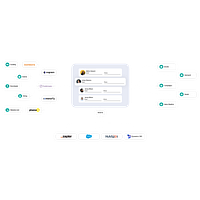
CRM migration
Field-level mapping, validation, and rollback between Plezi and HubSpot. We move data and schema; workflows are rebuilt natively in HubSpot.

Plezi
Source
HubSpot
Destination

Compatibility
11 of 11
objects map 1:1 between Plezi and HubSpot.
Complexity
BStandard
Timeline
48–72 hours
Overview
Plezi organizes marketing automation data around contacts, companies, and campaigns with a proprietary scoring and workflow model. HubSpot uses its own object graph — contacts with lifecycle_stage properties, companies as separate CRM objects, deals tied to pipelines with stage values, and custom objects for Enterprise-tier portals. These structural differences mean the migration is not a direct record dump; it requires object-by-object field translation, owner resolution by email match, and explicit decisions on how Plezi scoring rules and campaign logic translate (or don't) into HubSpot's property and automation model. FlitStack AI uses HubSpot's REST API and Bulk API to extract Plezi records, maps every standard and custom contact/company/deal property, re-uploads engagement history as HubSpot engagements, and flags workflows and scoring rules as manual-rebuild items in the handoff package. A sample migration with field-level diff runs first; the full cutover includes a 24–48 hour delta pickup window so in-flight Plezi changes land in HubSpot at go-live. Reports, dashboards, and automation logic do not migrate — those are documented in the export package for your HubSpot admin to rebuild.
Every standard and custom field arrives verified.
AI proposes the map; you confirm before any record moves.
Parent–child, lookups, and ownership stay linked.
Calls, emails, meetings — with original timestamps.
Documents, uploads, and inline notes move with the record.
Why teams make this switch
Leaving
What's pushing teams away
Choosing
What's pulling them in
Object mapping
Each row shows how a Plezi object lands in HubSpot, including any object-level transformations, lookup resolution, or schema-design dependencies.
Typical mapping — final map is confirmed during the sample migration step.
Plezi
Contact
HubSpot
Contact
1:1Plezi contacts map 1:1 to HubSpot contacts. Every standard Plezi contact property — first name, last name, email, phone, job title — maps to the HubSpot contact property of the same name. Owner assignment in Plezi resolves by email match to a HubSpot user.
Plezi
Contact custom properties
HubSpot
Contact custom properties
1:1Plezi custom contact properties migrate as HubSpot custom contact properties. HubSpot requires the property to be created in HubSpot before import; FlitStack creates the property schema first, then maps values during the data load. Multi-select Plezi properties map to HubSpot multi-checkbox or multi-select fields based on type detection.
Plezi
Company
HubSpot
Company
1:1Plezi companies map directly to HubSpot companies. Standard company properties — name, domain, website, industry, employee count, annual revenue, phone, city, and country — map to HubSpot company properties with matching names. HubSpot's industry pick-list is mapped value-by-value to Plezi industry values, with unmatched selections flagged for manual review. Company create timestamps are preserved as custom datetime fields since HubSpot's built-in createdate reflects migration time.
Plezi
Company hierarchy (parent/child)
HubSpot
Company parent relationship
1:1Plezi company hierarchies map to HubSpot's parent company association. The child company's Parent Company property is set to the HubSpot company ID of the parent. Circular references are flagged and resolved before migration — a company cannot be its own ancestor.
Plezi
Contact-Company association
HubSpot
Contact-Company association
1:1Plezi contacts are associated with one or more companies, and these associations migrate to HubSpot as contact-company links. The primary company association in Plezi becomes the primary company on the HubSpot contact record. For Plezi contacts associated with multiple companies, secondary company associations are created in HubSpot where the portal tier supports them. The association migration uses HubSpot's association API to link contact and company records by their respective HubSpot IDs.
Plezi
Deal
HubSpot
Deal (HubSpot CRM object)
1:1Plezi deals map to HubSpot CRM deals. Deal name, amount, close date, owner, and stage map to HubSpot deal properties. HubSpot deals require a named pipeline; if Plezi uses a single pipeline, FlitStack creates one HubSpot pipeline. Multiple Plezi deal stages map to HubSpot deal stage values within that pipeline.
Plezi
Campaign
HubSpot
HubSpot campaign (or custom object)
1:1Plezi campaigns contain email sends, landing pages, and automation logic. HubSpot has a Campaign object that tracks marketing emails but not the campaign-level automation logic. FlitStack migrates campaign names and associated email send history as reference data; the automation logic must be rebuilt as HubSpot workflows. A campaign export package is delivered for your HubSpot admin.
Plezi
Engagement (email opens, clicks, form submissions)
HubSpot
Contact timeline / engagements
1:1Plezi engagement events (email open, click, form submit, page visit) are translated to HubSpot engagement timeline entries. Each event type becomes a distinct HubSpot engagement record on the contact timeline with the original timestamp and source preserved. Email metadata (subject, send date) migrates as a HubSpot email record.
Plezi
Notes / tasks
HubSpot
Contact timeline notes and tasks
1:1Plezi notes on contacts or companies migrate as HubSpot contact timeline notes. Tasks logged in Plezi migrate as HubSpot engagement tasks with the original due date and owner. Task completion status is preserved. Notes are not merged — each Plezi note becomes a distinct HubSpot timeline entry.
Plezi
Lead scoring data
HubSpot
Contact custom number property
1:1Plezi's lead scoring algorithm produces a numeric score per contact. This score migrates as a HubSpot custom number property (e.g., Plezi_Score__c) on the contact record. HubSpot does not replicate Plezi's scoring rules — those are rebuilt as HubSpot property-based workflows post-migration.
Plezi
File attachments
HubSpot
HubSpot file storage
1:1Plezi file attachments on contacts, companies, or deals are downloaded and re-uploaded to HubSpot's file storage. Files are linked back to the appropriate CRM record. Standard HubSpot file size limits (25 MB per file) apply; files exceeding this are flagged before migration.
| Plezi | HubSpot | Compatibility | |
|---|---|---|---|
| Contact | Contact1:1 | Fully supported | |
| Contact custom properties | Contact custom properties1:1 | Fully supported | |
| Company | Company1:1 | Fully supported | |
| Company hierarchy (parent/child) | Company parent relationship1:1 | Fully supported | |
| Contact-Company association | Contact-Company association1:1 | Fully supported | |
| Deal | Deal (HubSpot CRM object)1:1 | Fully supported | |
| Campaign | HubSpot campaign (or custom object)1:1 | Fully supported | |
| Engagement (email opens, clicks, form submissions) | Contact timeline / engagements1:1 | Fully supported | |
| Notes / tasks | Contact timeline notes and tasks1:1 | Fully supported | |
| Lead scoring data | Contact custom number property1:1 | Fully supported | |
| File attachments | HubSpot file storage1:1 | Fully supported |
Gotchas + challenges
Platform-specific issues from each side, plus the pair-specific challenges that don't show up on either platform's page on its own.
Plezi gotchas
Smart Campaign automation logic is not directly portable
Landing pages may contain non-exportable embedded content
Pricing is not publicly documented and varies by negotiation
HubSpot gotchas
Marketing Contacts billing model is migration-critical
Feature tier gating is not visible until onboarding
Mandatory onboarding fees inflate year-one cost
HubSpot CSV importer cannot migrate engagements or attachments
Custom objects require Enterprise and a pre-existing schema
Pair-specific challenges
Migration approach
Audit Plezi data and HubSpot schema readiness
FlitStack connects to Plezi via API and extracts a full inventory of contacts, companies, deals, custom properties, engagement history, and file attachments. We simultaneously audit your target HubSpot portal: which HubSpot tier you have, which standard properties already exist, whether custom properties need to be created, and whether the required deal pipelines and stages are configured. The output is a Data Readiness Report listing record counts per object, unmapped properties, duplicate risks, and a schema pre-flight checklist for your HubSpot admin to complete before data lands.
Create HubSpot custom properties and pipeline schema
Before any data moves, FlitStack creates the HubSpot custom properties needed for Plezi data that has no standard HubSpot equivalent. This includes Plezi_Score__c, Original_Create_Date__c, and any custom contact/company/deal properties detected in the audit. If Plezi uses a pipeline structure, we create the corresponding HubSpot pipeline with stage values mapped to Plezi's deal stages. Your HubSpot admin reviews and approves the property list; FlitStack creates them via the HubSpot Properties API so they are available before the import runs.
Resolve owners and deduplicate existing records
FlitStack builds an owner resolution map by matching Plezi owner email addresses against existing HubSpot users. Any Plezi owner without a HubSpot match is flagged with the record count affected so your team can either invite them to HubSpot or assign a fallback owner. Separately, we scan for duplicate contacts (same email), duplicate companies (same domain), and duplicate deals (same name plus close date) between Plezi and any existing HubSpot data. The deduplication strategy — update existing vs. create new — is applied per your specified rule and confirmed before the migration run.
Run sample migration with field-level diff
A representative slice of records — typically 200–500 across contacts, companies, deals, and a sample of engagement events — migrates first. FlitStack generates a field-level diff report comparing Plezi source values against the corresponding HubSpot properties after import. You verify that lifecycle_stage values resolved correctly, deal amounts populated, company associations linked, and engagement timestamps are accurate. Any mapping errors are corrected in the migration configuration before the full run commits. The sample migration gives your team confidence that the full migration will land correctly without surprises.
Execute full migration with delta pickup window
The full dataset migrates to HubSpot using the validated mapping from the sample phase. After the initial load completes, a delta pickup window of 24–48 hours captures any records created or modified in Plezi during the cutover period — your team keeps working in Plezi until go-live. FlitStack performs a post-migration reconciliation audit comparing total record counts, property fill rates, and association completeness between Plezi and HubSpot. If reconciliation fails, one-click rollback reverts the HubSpot portal to its pre-migration state. An export package containing Plezi workflow definitions, scoring rules, and campaign logic is delivered alongside the migration for your HubSpot admin to rebuild.
Platform deep dives
Plezi
Source
Strengths
Weaknesses
HubSpot
Destination
Strengths
Weaknesses
Complexity grading
Standard CRM migration. 3 of 8 objects need a mapping; the rest are 1:1.
Overall complexity
Standard migration
Derived from compatibility, mapping clarity, API constraints, and data volume across Plezi and HubSpot.
Object compatibility
3 of 8 objects need a mapping; the rest are 1:1.
Field mapping clarity
Field mapping is derived from defaults — final spec confirmed during the sample migration.
Timeline complexity
8-object category — typical timelines run 2–7 days end-to-end.
API constraints
Plezi: Not publicly documented — typical SaaS limits assumed and confirmed during scoping.
Data volume sensitivity
Plezi exposes a bulk API — large-volume migrations stream efficiently.
Estimator
Rule-based pricing — no per-record fees, no manual quotes. Migrations over 2M records are scoped individually.
Step 1
Pick a category, then your source and destination platforms.
Category
FAQ
Answers to the questions buyers ask most during Plezi to HubSpot migration scoping. Not seeing yours? Book a call.
Walk through your Plezi to HubSpot migration with a real engineer — 30 minutes, free, written quote within 24 hours.
Book a free 30 minute consultationAdjacent paths
Other ways to leave Plezi
Other ways to arrive at HubSpot
Popular CRM migrations










Ready when you are
Tell us record counts and timeline. We'll come back with a written quote inside 1 business day — no commitment, no sales pitch.